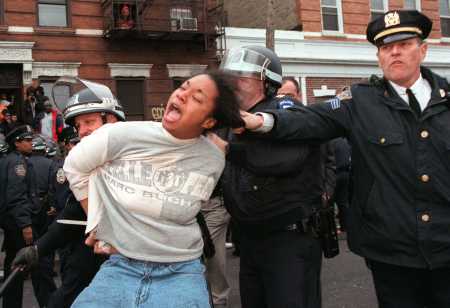
Someone may wonder, how do these police officers go about stopping people? Well they should go about it by following the guidelines set up by the federal government and/or impartial rational reasoning produced by experience, not based on skin color or community. The federal standards for stop and frisk were set in a landmark Supreme Court case, Terry v. Ohio in 1968. The ruling made probable cause unnecessary to make stops on the street, they said an officer needs articulate "reasonable suspicion", a belief, based on experience, observation, and/or prior knowledge, that the person is in the process of carrying out a crime. New York has its own standards that are more subtle and have been established in People v. Debour. The Debour levels of stop and frisk were established, where escalating levels of intrusion of a stop are categorized into four levels. To initiate any kind of questioning, either harmless inquiry or intimidating interrogation police must have an objective or credible reason, not necessarily initial criminal suspicion for their questioning. Alot of people do not know, I didn't, Federal and New York have made it clear that you have the right to not answer or physically evade questions without the fear of pursuit and you may even refuse to provide proof of identity, all legal. New York Courts have also established that police officers may not base "reasonable suspicion" on the refusal to provide proof of identity and/or the disregarding and evading of questioning.
The levels of intrusion are as follows:
- The first level of intrusion is harmless police questioning, that you don't have to answer or adhere to, of your identity, reason for being where you are, and travel plans; they must have an objective and credible reason still to ask these questions; still a "stop" has not occured.

- The second level of is when an officer closely and intensly questions a citizen to gain information beyond travel plans, still not a stop because the citizen has the right to leave legally; at the second level the officer must have suspicion that crime is afoot.
- The third level is when the citizen is actually detained and now a stop has occurred. In order to make an official stop where a citizen is not able to walk or exercise their right to be left alone a police officer must "entertain reasonable suspicion that a particular person has committed, is committing, or is about to commit a felony or misdemeanor." An officer may frisk a suspect if the officer feels that he/she poses a threat of physical injury in the event of the detainee being armed.
- The fourth level of intrusion is the arrest itself. At this arresting level the officer must have probable cause that the detainee has committed a crime or offense in his presence.

Also a bulge in the pocket is not enough to warrant a stop because it could be any object. A waistband bulge is enough to warrant an official stop because it could be a gun; the touching of the waistband or waist area upon questioning could lead an officer to believe that the person possesses a weapon and lead to a frisk being performed. The only way a stop can be made due to a pocket bulge is if the shape of the bulge can be articulated and defined by the officer as a firearm.
Police Practices and Civil Rights in New York City
"Stop & Frisk" Report - Chapter 2, Part 1